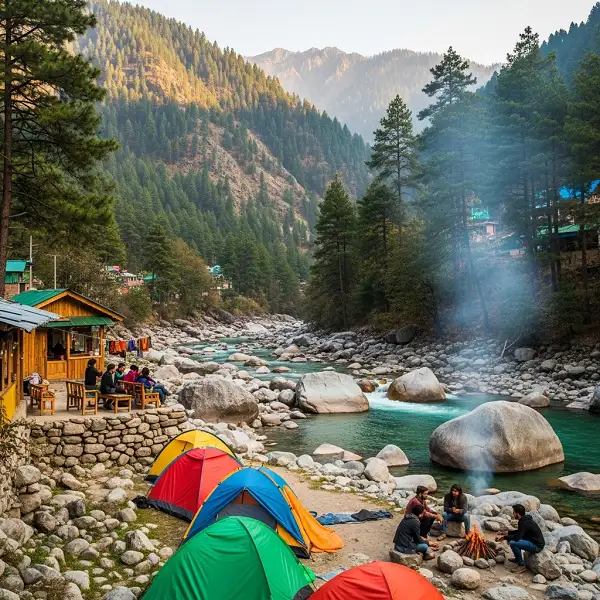
Kasol is where the mainstream backpacker trail begins — and where, if you know where to look, it quietly dissolves into something far more interesting. Behind the Bob Marley murals and Israeli falafel boards, Parvati Valley is a deeply complex landscape: dense forests opening onto high-altitude meadows, villages with their own democratic governance and unique languages, hidden hot springs above the treeline and camping grounds where the night sky is genuinely dark. This guide covers the Kasol that the cafes don't tell you about — and the local mountain cab drivers who can get you there safely.
Why a Local Mountain Driver Makes All the Difference
Narrow Road Expertise
The track to Tosh, Pulga and Barshaini is single-lane, unpaved in sections and prone to rockfall. Local drivers have years of experience on these specific roads in all seasons.
Village Community Ties
Grahan, Rashol and Tulga are small traditional villages where strangers receive a very different welcome than guests introduced through a known local contact.
Weather & River Alerts
Parvati Valley is one of Himachal's highest-rainfall zones. Our drivers get daily alerts from village contacts about river levels, trail conditions and closures before they appear online.
Right Vehicle for the Route
The Tosh road requires a capable 4WD after rain. Barshaini switchbacks are tight. Our vehicles are selected and maintained specifically for upper Parvati Valley terrain.
Kullu Pahari Dialect
The village culture is Himachali. Our drivers speak the local Kullu Pahari dialect, smoothing every interaction from homestay negotiation to trekking guide introductions.
Timing and Combinations
Reaching Kheerganga trailhead at 6:30 AM to beat afternoon rain, or Grahan before the evening mist closes the path — local timing knowledge is the difference between a great day and a wasted one.
Kasol's Best Hidden and Offbeat Places
Grahan Village — Himachali Culture Unchanged
Grahan sits 5 kilometres above Kasol in a dense oak and rhododendron forest, connected to the valley only by a walking trail. This is partly why it has retained an atmosphere that most Himachali villages lost to road access a generation ago — traditional slate-roofed stone houses, a working village temple of real antiquity, and families who grow their own produce and live on a calendar shaped by agricultural seasons rather than tourist arrivals.
The village has basic homestays offering wood-fire cooking and traditional Himachali food — rajma chawal, local saag, thick rotis — served in the family's main room. No cafes, no menus, no wifi. The 2–3 hour trek rewards you on arrival with a view back down the forested valley that justifies every step. Our drivers drop you at the Kasol trailhead early and collect the following day, or arrange a local guide for a day return.
Kheerganga Hot Springs — Above the Tourist Trail
Kheerganga has become well-known enough that the main hot spring pool is busy from mid-morning in peak season. What most visitors don't know is that additional smaller thermal seeps exist in the forest above the main clearing — located by following steam through the treeline rather than the path to the main pool. Our drivers brief trekkers before the start on exactly where the secondary pools are and the best timing: very early morning (before 7 AM) to have them entirely alone.
Kheerganga itself is a beautiful destination regardless — the trail follows the Parvati River through forest and open slopes, rising to a flat meadow at 2,950 m with a Shiva temple and mountain views in every direction. Our drivers take you to Barshaini at 6–7 AM for the best experience and wait for your return.
Tulga — Secret Camping Beyond Tosh
Tosh has become crowded enough to have its own rooftop cafes. Tulga, the settlement a kilometre or two beyond on the high ridge, remains entirely unknown to most visitors. Our drivers know the flat riverside camping spots here that local shepherds use during summer grazing — sites with genuinely zero light pollution, an unobstructed Milky Way view on clear nights and the kind of silence that is almost disorienting after a week in busy Kasol.
Reaching Tosh requires a confident 4WD on a very rough track (our drivers make this run regularly). The onward walk to Tulga from Tosh takes 45 minutes. Best visited on clear new-moon nights in October–early November when the galactic core is visible and temperatures are still above freezing. We can arrange tent and sleeping bag rentals in Kasol if needed.
Pulga Village — The Quiet End of the Valley
Pulga sits at the far navigable end of the upper valley road, beyond Barshaini and across a small suspension bridge. While Tosh has received increasing tourist attention, Pulga remains genuinely quiet — a small cluster of traditional houses and guesthouses surrounded by old-growth deodar cedar forest that the Himachali communities consider sacred.
The forest clearings around Pulga have an unusual atmospheric quality: the sheer scale of the old cedars, the filtered light, the sound of the Parvati below and the absence of any commercial noise create a stillness that is increasingly rare in accessible Himachal. An ideal base for those who want altitude and quiet with access to the Kheerganga and Pin Parvati trails. Our drivers make the Barshaini–Pulga run regularly and know the bridge crossing conditions in every season.
Malana — The Ancient Democratic Republic
Malana is one of the most remarkable villages in India — a community with its own democratic governance (Jamdagni Rishi's laws), a unique language called Kanashi with no documented relationship to any other living language family, and cultural practices that have preserved the village's distinctiveness through centuries of external contact.
Visiting Malana requires genuine cultural sensitivity: do not touch locals, their homes, walls or temples; stay on designated paths; photograph only with explicit, unprompted permission. Our drivers brief all visitors thoroughly before arriving and have long-standing respectful relationships in the village that enable introductions to elders who share oral history and tradition.
Rashol — Hidden Monastery Among Apple Orchards
Rashol Pass and the village of Rashol sit above Kasol on the southern ridge, reached by a 3-hour forest trek through pine forest transitioning to apple orchards and open meadow. The village hosts a monastery that local accounts date to over 500 years old — its prayer hall containing thangkas and butter lamps maintained by resident monks who welcome respectful visitors for meditation and quiet reflection.
The view from Rashol back across the Parvati Valley is one of the finest mid-altitude panoramas in this part of Himachal — Kasol invisible in the pine forest below, the Kullu valley opening up beyond. Most visitors in the valley below have no idea this view exists above them. Combine with a Rashol Pass crossing for a full-day circuit, or treat as an out-and-back from Kasol.
Best Time to Visit Kasol and Parvati Valley
🌸 March – June (Spring)
Rhododendron bloom on the Grahan trail, Kheerganga trail fully open, apple orchards in flower near Rashol. Warm days, cool nights. Most trails accessible. Good for all offbeat destinations.
🍂 October – November (Autumn)
The finest season — clear skies, apple harvest in villages, dry trails, dark night skies ideal for Tulga astrophotography. Kheerganga quieter. Cold at night above 2,500 m but manageable with layers.
🌧 July – September (Monsoon)
Avoid if possible. Parvati Valley receives very heavy rainfall. Flash floods, trail closures and bridge washouts are common. Kheerganga trail frequently closed. The 2014 and 2021 floods were severe.
❄ December – February (Winter)
Snow closes upper valley roads (Tosh, Pulga, Barshaini). Kasol itself remains accessible. Kheerganga trail closed. Good for quiet walks in Kasol and Chalal with very few tourists.
Suggested 3-Day Parvati Valley Offbeat Itinerary
Kasol and Parvati Valley Cab Fares 2025
| Route / Tour | Details | Sedan | SUV / 4WD |
|---|---|---|---|
| Bhuntar to Kasol | One way, 30 km | Rs. 800–1,200 | Rs. 1,200–1,600 |
| Kasol to Barshaini | Drop + wait or return, 18 km | Rs. 1,200–1,800 | Rs. 1,800–2,500 |
| Kasol to Tosh | Rough track — 4WD essential | Not recommended | Rs. 2,500–3,500 |
| Kasol–Jari–Malana drop | Half-day tour including wait | Rs. 1,500–2,000 | Rs. 2,200–3,000 |
| Full Valley Day Tour | Manikaran + Barshaini + Tosh / Pulga | Rs. 2,800–3,800 | Rs. 4,000–5,500 |
| Delhi to Kasol | 510–530 km, 10–12 hrs | Rs. 9,000–11,500 | Rs. 13,000–17,000 |
| Chandigarh to Kasol | 270 km, 5–6 hrs | Rs. 5,500–7,000 | Rs. 8,000–10,500 |
All fares include driver, fuel and tolls. Tosh route requires 4WD — sedan not suitable beyond Barshaini. Call +91 96254 51988 to book.
Explore the Real Parvati Valley with a Local Driver
Cab pickup from Bhuntar, Delhi or Chandigarh — plus valley day tours, Kheerganga trailhead drops and Tosh and Malana access with expert mountain drivers.
Book Now +91 96254 51988Frequently Asked Questions — Kasol and Parvati Valley
Q: What are the best hidden places near Kasol in Parvati Valley?
A: Grahan village (5 km forest trek, authentic Himachali culture and homestays), Tulga beyond Tosh (secret camping with star-filled skies and zero light pollution), Rashol monastery (3-hour trek to a 500-year-old Buddhist sanctuary with valley panoramas), Pulga village (sacred old-growth deodar forest, quieter than Tosh) and the secondary Kheerganga hot spring seeps above the main pool.
Q: How do I get from Delhi or Chandigarh to Kasol?
A: Kasol is 510–530 km from Delhi (10–12 hrs, cab from Rs. 9,000) and 270 km from Chandigarh (5–6 hrs, from Rs. 5,500). Nearest railhead is Bhuntar (30 km from Kasol). We provide cab pickup from Delhi Airport, Chandigarh and Bhuntar to Kasol and all valley destinations. Call +91 96254 51988.
Q: What is the Grahan village trek and how long does it take?
A: A 5 km forest trail from Kasol taking 2–3 hours one way. Grahan is a traditional Himachali village with basic homestays, wood-fire cooking and an authentic highland atmosphere unchanged from decades ago. Ideal for genuine cultural immersion away from the Kasol backpacker scene.
Q: Is it safe to trek alone in Parvati Valley?
A: The main Kasol–Kheerganga trail is well-marked and safe for fit trekkers. For Grahan, Rashol, Tulga or beyond Kheerganga, a local guide or driver who knows the terrain is strongly recommended — especially in monsoon when trails become slippery and rivers rise rapidly.
Q: What is the best time to visit Kasol and Parvati Valley?
A: October–November (clearest skies, dry trails, apple harvest, fewer tourists) and March–June (spring bloom, warm days, rhododendron). Avoid July–September — Parvati Valley has very heavy monsoon rainfall with serious flash flood risk. Upper valley roads (Tosh, Pulga) close December–February.
Q: What are the cab fares from Bhuntar to Kasol?
A: Bhuntar to Kasol Rs. 800–Rs. 1,200 sedan. Kasol to Barshaini Rs. 1,200–Rs. 1,800. Kasol to Tosh (4WD essential) Rs. 2,500–Rs. 3,500. Full valley day tour from Rs. 2,800. Call +91 96254 51988.
Q: What should I pack for Kasol and Parvati Valley treks?
A: Waterproof trekking shoes, warm layers, rain jacket, INR cash (no ATMs beyond Kasol town), headlamp, basic medicines and a refillable water bottle. Download offline maps on Maps.me before leaving Kasol — mobile data disappears quickly above the valley floor.
Q: Can I visit Malana village from Kasol?
A: Yes — via Jari (15 km from Kasol) then a 3–4 km uphill walk. Malana has strict cultural rules: do not touch locals, homes or temples; stay on marked paths; photograph only with explicit permission. Our drivers provide a full cultural briefing before your visit and have long-standing respectful ties in the village.