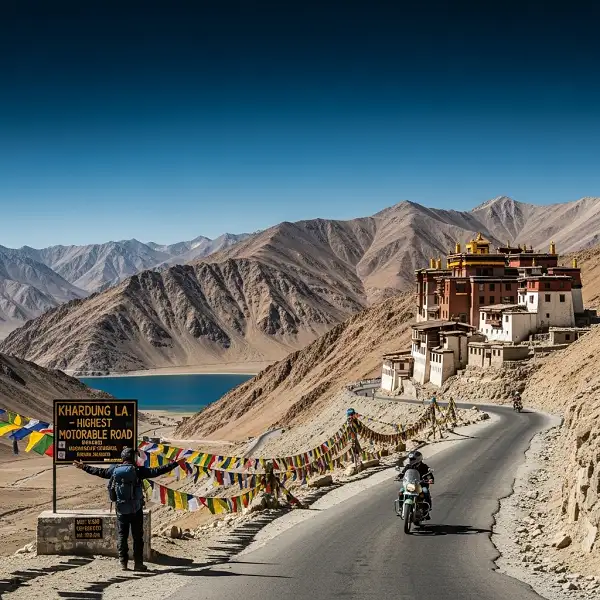
Ladakh is not simply a destination — it is a genuinely different relationship with the earth. At altitudes where most cities would be above the clouds, the landscape strips away everything decorative and leaves behind something elemental: impossibly blue lakes set in bare brown mountains, monastery walls painted in primary colours against colourless rock, roads that cross passes higher than many country's tallest peaks. Getting there safely and fully requires drivers who understand not just mountain roads, but acclimatisation, passes that can close in hours, permit systems, and where to be at dawn for the light that makes Pangong look like a painting rather than a photograph. This guide covers Ladakh's essential destinations and how our expert cab drivers make them accessible, safe and genuinely extraordinary.
Why High-Altitude Driving in Ladakh Requires a Specialist
Altitude Management
Passes above 5,000 m can induce AMS symptoms rapidly. Our drivers carry supplemental oxygen, know rest stop protocols and plan ascent rates that let bodies adjust before push.
4WD Mountain Expertise
The Chang La and Khardung La approaches involve steep switchbacks, loose scree roads and river crossings. Our vehicles are maintained for these conditions, not merely capable in them.
Permit Navigation
Pangong, Nubra Valley and Tso Moriri all require Inner Line Permits. Our drivers know current requirements, assist with paperwork and ensure no checkpoint stops your journey.
Weather and Pass Status
Ladakh passes can close without warning due to snowfall even in summer. Our drivers receive daily BRO (Border Roads Organisation) updates and know alternate routes when passes are blocked.
Remote Route Knowledge
Tso Moriri, Zanskar and the Pangong-Hanle circuit involve roads not on any map app. Local drivers navigate by landmark and seasonal route knowledge accumulated over years of runs.
Emergency Communication
Mobile networks disappear beyond Leh town. Our drivers carry satellite communication equipment and maintain emergency contact with Leh-based support at all times on remote routes.
Ladakh's Essential Adventure Destinations
Pangong Tso — The Shifting Blue Lake
Pangong Tso — the name means "high grassland lake" in Tibetan — stretches 134 km across the India-China border at 4,350 m altitude, and it is genuinely one of the most extraordinary bodies of water on earth. The colour shifts from turquoise to cobalt to near-black as the sky changes, with absolutely no vegetation on the surrounding mountains to contextualise or soften the landscape. The result is something closer to a digital render than a photograph — except that it is real and you are standing in it.
Reaching Pangong requires crossing Chang La 5,360 m, one of the world's highest motorable passes — a cold, vertiginous climb with prayer flags and the last tea stall before the descent to the lake. The BTS filming location from the movie "3 Idiots" is on the south bank, but the dawn light on the north bank (Spangmik village, accessible by our drivers) is the image most visitors carry home. We strongly recommend an overnight at Pangong to see the evening and morning light — the midday visit, while spectacular, is the least of what the lake offers.
Nubra Valley — Desert Dunes in the Himalaya
Nubra Valley sits in the rain shadow of the Karakoram and receives so little precipitation that actual sand dunes form at Hundar — a surreal juxtaposition of desert landscape backed by glaciated 7,000 m peaks. The Bactrian (double-humped) camels grazing on the dunes are descendants of animals that worked the ancient Silk Road trade routes between Ladakh and Central Asia, and their presence in this high-altitude sand landscape is one of India's more genuinely strange and beautiful sights.
Reaching Nubra means crossing Khardung La 5,359 m / 17,582 ft — the celebrated high pass with BRO tea stalls and a stream of motorcyclists taking photographs. The descent to Nubra is steep and spectacular. Diskit Monastery (14th century, with an enormous Maitreya Buddha statue facing the valley) and the white-sand beaches of the Shyok river add depth to what could otherwise be a single-image destination. Plan for 2 days — one night in Nubra lets you see the valley in evening light and morning quiet before the day-trippers arrive.
Tso Moriri — The Undiscovered Lake
Tso Moriri is the lake that people who have been to Pangong Tso wish they had gone to instead. At 4,522 m — higher than Pangong — it sits in a wider, more sheltered valley that creates a completely different atmosphere: the surrounding mountains are rounder and more coloured, the nomadic Changpa herder community still lives in traditional black tents (rebos) on the eastern shore, and the black-necked cranes that winter here are one of the world's rarer bird sightings.
The drive from Leh via Chumathang hot springs (240 km, about 7–8 hours) passes through some of the most remote inhabited terrain in India. There are no tourist crowds, almost no souvenir vendors and genuinely no mobile network. The Korzok village guesthouses on the western shore offer the most atmospheric overnight in Ladakh — sitting by a butter-lamp-lit window watching the lake change colour at dusk. Our drivers know the road thoroughly including the river crossings at Mahe and the correct route after the BRO checkpoint.
Hemis & Thiksey Monasteries — Living Buddhist Heritage
The Indus Valley south of Leh contains the highest concentration of functioning Buddhist monasteries in Ladakh — each at a different altitude, in a different architectural style and with a different atmosphere. Thiksey Monastery (19 km from Leh) is the most visually dramatic — a 15th-century complex climbing a rocky hill above the Indus valley in a direct visual echo of the Potala Palace in Lhasa, with a 15-metre Maitreya Buddha statue and 5:30 AM morning puja that is one of the most atmospheric experiences in Ladakh. Hemis (45 km) is the wealthiest monastery in Ladakh, housing exceptional thangka paintings and a maskdance festival in June–July. Alchi (70 km) contains 1,000-year-old wall paintings of enormous art historical importance, preserved by remoteness.
Our drivers plan morning monastery visits timed around puja hours and combine 3–4 monasteries efficiently along the south Indus valley route — Shey, Thiksey, Hemis and Stakna are all within 15 km of each other, manageable in a single morning.
Zanskar Valley — The Last Frontier
Zanskar is the most isolated inhabited valley in India — cut off by snow for most of the year, accessible by road only from June to October, and in winter accessible only by the famous Chadar Trek along the frozen Zanskar river. The summer road from Kargil to Padum (the Zanskar capital) is 240+ km of some of the most dramatic mountain road in Asia — vertiginous gorges, rough surfaces and passes above 4,400 m. The reward is a valley that feels genuinely remote and unhurried: ancient villages, gompas (monasteries) perched on impossible rock spires, and the confluence of the Zanskar and Indus rivers at Nimu — visible from above as two completely different-coloured rivers meeting.
Our drivers who run the Zanskar route have done it for years and carry everything needed for roadside emergencies in this zone where there is no BRO presence and no mobile network. This is a journey for travellers who want the full measure of what Ladakh is, not just its greatest hits.
Acclimatisation Guide — The Most Important Part of Your Ladakh Trip
More Ladakh trips are ruined by altitude sickness than by bad weather or road closures combined. Leh sits at 3,500 m. Pangong Lake is at 4,350 m. Khardung La tops out at 5,359 m. Without proper acclimatisation, these numbers cause serious problems. This is our recommended protocol:
Day 1 — Arrival
Rest completely. No exertion. Drink 3–4 litres of water. No alcohol. Sleep early. Let the body begin adjusting to 3,500 m.
Day 2 — Local Acclimatisation
Gentle walks around Leh town. Shanti Stupa (short uphill). Do not go above 3,800 m. Monitor for AMS symptoms: headache, nausea, fatigue.
Day 3 — First Excursion
South Indus valley monastery circuit (Thiksey, Hemis, Shey) — max altitude 3,700 m. Good first full day with no severe altitude change.
Days 4–5 — High Passes
Nubra Valley via Khardung La (5,359 m) or Pangong via Chang La (5,360 m). Body is now adjusted for the climb. Spend minimal time above 5,000 m.
Days 6–7 — Remote Lakes
Tso Moriri (4,522 m) or Hanle circuit. By day 6, most bodies are fully acclimatised and can handle extended time at high altitude comfortably.
Suggested 7-Day Leh Ladakh Cab Itinerary
Leh Ladakh Cab Tour Fares 2025
| Tour / Route | Details | Innova/Sumo (6-7 pax) | Tempo Traveller (10-12 pax) |
|---|---|---|---|
| Leh Local Sightseeing | Palace, Stupa, Market, Monasteries — 1 day | Rs. 2,500–3,500 | Rs. 4,000–5,500 |
| South Indus Monastery Circuit | Thiksey + Hemis + Shey + Stakna — 1 day | Rs. 3,000–4,000 | Rs. 4,500–6,000 |
| Pangong Lake Day Tour | Chang La + Pangong, same day return | Rs. 6,000–8,500 | Rs. 9,000–12,000 |
| Pangong Overnight Tour | Chang La + Pangong overnight + return | Rs. 8,500–11,000 | Rs. 12,000–16,000 |
| Nubra Valley 2-Day Tour | Khardung La + Diskit + Hundar + Shyok + return | Rs. 9,000–12,000 | Rs. 13,000–17,000 |
| Tso Moriri 2-Day Tour | Chumathang route + Korzok overnight + return | Rs. 10,000–14,000 | Rs. 15,000–20,000 |
| Complete 7-Day Ladakh Tour | Monasteries + Nubra + Pangong + local sightseeing | Rs. 38,000–50,000 | Rs. 55,000–75,000 |
| Manali to Leh (2 Days) | 479 km via 5 passes, overnight Jispa or Sarchu | Rs. 14,000–18,000 | Rs. 20,000–27,000 |
All fares include driver, fuel and tolls. Permits, accommodation and entry fees paid separately. Sedan cars are not recommended for Ladakh — Innova, Sumo or equivalent 4WD essential. Call +91 96254 51988 for custom quotes.
Book Your Leh Ladakh Adventure
Expert high-altitude drivers, 4WD vehicles, acclimatisation-planned routes, oxygen support and permit assistance — Ladakh done safely and completely.
Book Now +91 96254 51988Frequently Asked Questions — Leh Ladakh Adventure
Q: What is the best time to visit Leh Ladakh?
A: June–September when all passes are open, weather is stable and all destinations are accessible. July–August are warmest. Late September brings autumn colour to the Indus valley. The Manali–Leh road typically opens in late May and closes October–November.
Q: How do I get from Delhi or Manali to Leh by road?
A: Two main routes — Manali–Leh Highway (479 km, 2 days with overnight in Jispa or Sarchu, open June–October) and Srinagar–Leh NH1 (434 km via Kargil, open May–November). YourTripDriver provides cab service on both routes with acclimatisation-planned stops. Call +91 96254 51988.
Q: How far is Pangong Lake from Leh and what is the cab fare?
A: 160 km from Leh, approximately 5–6 hours via Chang La (5,360 m). Day tour: Rs. 6,000–Rs. 8,500 (Innova/Sumo). Overnight tour: Rs. 8,500–Rs. 11,000. Chang La requires a 4WD vehicle — sedan cars are not suitable.
Q: How do I get to Nubra Valley from Leh?
A: 150 km from Leh via Khardung La (5,359 m) — 4–5 hours. Standard 2-day tour (Khardung La + Diskit + Hundar dunes + overnight + return): Rs. 9,000–Rs. 12,000 (Innova/Sumo). Inner Line Permit required — our drivers assist with documentation.
Q: Do I need a permit to visit Pangong Lake and Nubra Valley?
A: Yes — both require an Inner Line Permit (ILP) for Indian nationals and a Protected Area Permit (PAP) for foreign nationals. Tso Moriri also requires an ILP. Permits are obtained in Leh town and processed within a few hours. Our drivers assist with the complete permit process.
Q: What is altitude sickness and how do I acclimatise in Leh?
A: Altitude sickness (AMS) occurs when the body adjusts inadequately to reduced oxygen. Leh is at 3,500 m. Rest completely on arrival day, avoid exertion for 48 hours, drink plenty of water and avoid alcohol. Begin high-altitude passes only from day 3 onward. Our drivers carry supplemental oxygen and know rest stop protocols for every high-altitude route.
Q: What is the road condition on the Manali to Leh Highway?
A: 479 km crossing five passes above 4,500 m. Conditions vary by season and weather. Landslides can close sections without warning. Our drivers have daily BRO road updates and plan overnights at Jispa (Day 1) and Sarchu or Pang (Day 2) for safe two-day completion.
Q: What is the cost of a complete Ladakh tour by cab?
A: A 7-day tour (monasteries + Nubra Valley + Pangong Lake + local) costs Rs. 38,000–Rs. 50,000 for an Innova/Sumo (4–6 passengers), excluding accommodation, permits and entry fees. Add the Manali–Leh drive for Rs. 14,000–Rs. 18,000 more. Call +91 96254 51988 for a custom quote.