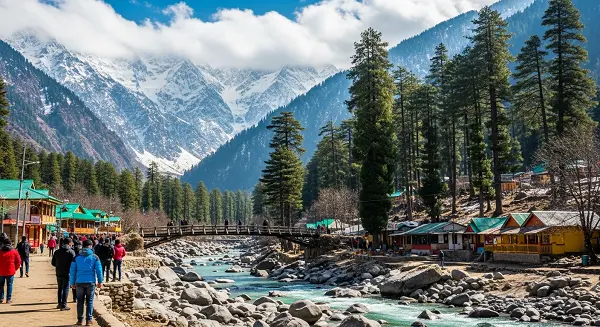
Most Manali tourists follow a single predictable loop: Mall Road, Solang Valley, Rohtang Pass, back to Mall Road. It is perfectly enjoyable. It is also shared with several thousand other visitors on any given summer day. The Manali that local drivers know sits just beyond this circuit — a 14th-century castle village on the left bank where the Beas valley opens up to a view that no amount of Instagram saturation has dulled, a high alpine meadow above the treeline that most people staying in Manali don't know exists, river gorge viewpoints that take ten minutes to reach and reward with thirty minutes of silence. This guide covers the Manali that the travel agents don't mention — and the local cab drivers who can take you there without the crowds.
Why a Local Manali Driver Opens the Real Valley
Left-Bank Road Knowledge
The left-bank road to Naggar bypasses the busy Kullu highway entirely — quieter, more scenic and rarely used by tourists. Local drivers know every junction and shortcut on both sides of the Beas.
Orchard and Village Access
Apple orchards in Naggar and Old Manali are on private land. Our drivers have long-standing family ties with orchard owners who welcome introduced guests for tastings — invisible to walk-in visitors.
Right Vehicle for Sethan
The road to Sethan meadow is rough and steep — sedans and shared taxis don't run it reliably. Our SUVs are maintained for this approach and our drivers know the conditions by season.
Timing Without the Crowds
Arriving at Gulaba viewpoint at 7 AM before the Rohtang queue builds, or reaching Old Manali temple at the 6 AM morning aarti — local timing knowledge transforms every destination.
Kullu Valley Dialect
Village interactions in Naggar, Prini and Kothi happen in Kullu Pahari. Our drivers are born in the valley and broker introductions that English alone simply cannot open.
Photography Windows
Naggar castle in morning mist, Sethan meadow at first light before cloud builds, Kothi gorge in the golden hour — local drivers know when each site is at its most extraordinary.
Manali's Best Offbeat and Hidden Destinations
Naggar Village & Castle — The Valley's Forgotten Capital
Naggar was the capital of the Kullu kingdom for over 1,400 years before the British shifted the district headquarters to Kullu town in 1862 — and it shows. The 15th-century Naggar Castle, built in the traditional Pahari style of alternating timber and stone (locally called kath-kuni construction), sits on a terrace above the valley with a view of the entire Kullu valley spread below. Parts of the castle are now a heritage hotel, but the ground floor is open to visitors and contains temple rooms of real antiquity. The wider village around the castle preserves wooden-balconied houses, stone-paved lanes, stone-carving workshops and a cluster of ancient temples that represent the valley's pre-tourist architectural character with remarkable completeness.
The Nicholas Roerich Art Gallery, 5 minutes below the castle, is genuinely one of the finest small art museums in Himachal Pradesh — the Russian painter and philosopher lived and died at Naggar in 1947, and the gallery contains a significant collection of his large-format Himalayan paintings alongside his personal library and correspondence. Most visitors to Manali have never heard of it. Our drivers take the left-bank road from Manali (avoiding the Kullu highway entirely), passing through Prini village apple orchards before climbing to the castle — a journey that is itself pleasantly scenic.
Old Manali Orchards & Manu Temple — Above the Tourist Town
Old Manali is 1.5 km above the main bazaar but is separated from it by decades in atmosphere. The Manu Rishi Temple at its centre — dedicated to the sage Manu, considered the origin of human civilisation in Hindu cosmology — is one of the Kullu valley's most sacred sites, with a 6 AM morning aarti that is deeply atmospheric and attended almost entirely by local families rather than tourists. The lanes radiating from the temple wind past old wooden-balconied houses, apple trees growing from stone walls and small family guesthouses run by the same families for three generations.
In apple season (August–October), the orchards above Old Manali are at their most beautiful — the trees heavy with fruit against the backdrop of the first snow on the peaks above. Our drivers know which orchard families welcome visitors for tastings and which lanes lead to the viewpoints above the village that look back down the entire Kullu valley. A morning in Old Manali combined with an afternoon in Vashisht (the hot-spring village across the river, equally traditional and equally overlooked) makes an excellent full day without touching the Mall Road circuit at all.
Sethan Meadow — The Alpine Bowl Above Manali
Sethan is one of Manali's most complete secrets — a high alpine village and meadow 14 km above the town at 2,700 m, sitting in an open bowl above the treeline with unobstructed views of Deo Tibba (6,001 m), the Pir Panjal range and the approach to Hampta Pass. The road to Sethan is rough enough that most rental vehicles and shared taxis decline to run it, which is precisely why the meadow receives almost no day-trip tourists despite being less than 45 minutes from Manali's Mall Road.
In July and August, the meadow fills with wildflowers — the density and variety matching anything in the more famous high valleys of Himachal. In winter (December–February), Sethan becomes a small, genuinely undiscovered ski area, with slopes that local families have been skiing for decades while Solang Valley's expensive infrastructure gets all the attention. It is also the starting point for the Hampta Pass trek — fit day-trekkers can walk to the Hampta base meadows (2–3 hours from Sethan) and return the same day, with our driver waiting at Sethan. This is one of the finest day walks accessible from Manali, and virtually no one does it.
Kothi Valley & Gulaba — The Gorge and the Panorama
Most visitors on the Rohtang road pass through Kothi and Gulaba without stopping — focused on the pass ahead. Kothi village (15 km from Manali) sits above a dramatic Beas river gorge with viewpoints looking down into a narrow canyon where the river runs turquoise between sheer walls — a composition that is more Patagonia than Himachal and is almost entirely unphotographed because visitors are looking at the peaks rather than down. The shepherd settlements above Kothi towards the Rohtang meadows are accessible on foot and largely intact — temporary black tents, grazing sheep and the smell of wood-smoke in a landscape that has not changed perceptibly in a century.
Gulaba (25 km from Manali) is the turn-off point for a 20-minute walk to a ridge viewpoint that looks back across the entire Beas valley — Manali below, the Dhauladhar on one side, Rohtang above and the Deo Tibba massif ahead. Hanuman Tibba (5,982 m) and the Seven Sisters peaks are identifiable by name here, and the view is genuinely 270 degrees of Himalaya. Our drivers bring you to Gulaba by 7 AM before the Rohtang queue fills the road, leaving the viewpoint entirely to you.
Vashisht Village & Hot Springs — The Other Bank
Vashisht sits directly across the Beas river from Manali, connected by the new bridge, and manages to feel several decades quieter despite being 3 km from Mall Road. The Vashisht Rishi Temple complex is one of the most important in the Kullu valley — ancient stone temple with elaborately carved wooden facades, a large sacred tank fed by the sulphur springs, and a bathing ghat history where pilgrims have been coming since before Manali existed as a tourist destination. The sulphur hot spring baths below the temple are open year-round and are particularly extraordinary in winter when steam rises from the pools against snow-covered rooftops.
The village lanes above the temple climb past old stone houses, small family restaurants and a population of long-term international travellers who discovered years ago that Vashisht offers Manali's views at half the noise and three-quarters of the price. The ridge above Vashisht gives a complete view of the Manali bowl and the Rohtang approach that no viewpoint in the main town can match.
Solang Valley Forest Route — Before the Activity Crowds
Solang Valley in peak season is a commercial adventure sports zone — paragliding, zorbing, snowmobile rides and a constant backdrop of Hindi film music from activity stalls. But at 7 AM on a clear morning, before the operators arrive, the upper meadows of Solang are one of the finest views in the Manali region: snow peaks framing a wide flat valley with the Beas Kund glacier visible at the head, and not another person in sight.
The forest route via Dhungri temple (passing through a beautiful old deodar cedar grove with a small Hadimba-associated temple) approaches Solang from the forest side rather than the main road — reaching the upper meadow before the day's activity setup begins. Our drivers use this approach route and time the arrival for the morning window. Combine with an early descent back through the Dhungri forest and breakfast in Old Manali for a perfect half-day that avoids the Solang Valley that most tourists experience entirely.
Best Time for Manali's Offbeat Places
🌸 April – June (Spring)
Apple blossoms in Naggar and Old Manali orchards. Sethan road opens in May. Beas river at full spring melt flow for Kothi gorge views. Excellent weather and clear skies.
🌿 July – August (Wildflower Season)
Sethan meadow and Hampta base at their wildflower peak — the finest season for high meadow photography. Orchard leaves green in Naggar. Some afternoon cloud but mornings clear.
🍂 September – October (Apple Harvest)
The finest overall season — apple harvest in Old Manali and Naggar, autumn colour beginning, clear skies throughout. Crowds thin from late September. Best photography light of the year.
❄ November – March (Snow Season)
Snow covers Sethan (undiscovered skiing), Vashisht hot springs are most atmospheric with steam against snow. Naggar and Old Manali remain accessible. Solang and Rohtang approaches closed Dec–Apr.
Suggested Manali Offbeat Day Itinerary
Manali Offbeat Tour Cab Fares 2025
| Tour / Route | Covers | Sedan | SUV / Innova |
|---|---|---|---|
| Naggar Half-Day | Castle + Roerich Gallery + village lanes | Rs. 2,000–2,800 | Rs. 2,800–3,800 |
| Sethan Meadow Half-Day | Sethan village + meadow + Hampta base approach | Not recommended | Rs. 1,800–2,500 |
| Kothi & Gulaba | Kothi gorge + Gulaba viewpoint | Rs. 1,800–2,500 | Rs. 2,500–3,200 |
| Old Manali + Vashisht | Old village lanes + Manu Temple + Vashisht temple + hot springs | Rs. 1,200–1,800 | Rs. 1,800–2,500 |
| Complete Offbeat Full Day | Gulaba + Kothi + Old Manali + Naggar + Vashisht | Rs. 3,500–4,500 | Rs. 4,500–6,000 |
| Delhi to Manali | 530–560 km, 12–14 hrs overnight cab | Rs. 9,000–11,000 | Rs. 13,500–17,000 |
| Chandigarh to Manali | 310–340 km, 7–9 hrs | Rs. 5,500–7,000 | Rs. 8,000–10,000 |
All fares include driver, fuel and tolls. Sethan requires SUV — sedan not suitable on the rough approach road. Call +91 96254 51988 to book or customise.
Explore Manali Beyond the Crowds
Local expert drivers, left-bank routes, early morning departures and orchard introductions — the Manali your travel agent doesn't know.
Book Now +91 96254 51988Frequently Asked Questions — Manali Offbeat & Secret Routes
Q: What are the best offbeat and hidden places near Manali?
A: Naggar village and castle (22 km — medieval heritage, Nicholas Roerich Art Gallery, apple orchards), Sethan meadow (14 km above Manali — alpine wildflower bowl at 2,700 m), Old Manali orchards and Manu Temple, Kothi Beas gorge viewpoints, Gulaba 360-degree panorama and Vashisht village hot springs. Our local drivers know access routes and the right timing for all of these.
Q: How far is Naggar from Manali and is it worth visiting?
A: 22 km, about 45 minutes via the scenic left-bank road. Absolutely worth it — a 15th-century castle, genuinely unchanged village lanes and the Nicholas Roerich Art Gallery make it easily the best half-day trip from Manali. Far fewer visitors than Mall Road on any given day.
Q: What is Sethan village and how do I get there?
A: Sethan is a high-altitude village and alpine meadow 14 km above Manali at 2,700 m — base for Hampta Pass treks. The road requires an SUV. In July–August the meadow fills with wildflowers; in winter it becomes an undiscovered ski area. Our drivers make this run regularly in suitable vehicles.
Q: What is the best time to visit Manali's offbeat places?
A: April–June (apple blossoms, Sethan opens), July–August (wildflower peak at Sethan and Hampta base), September–October (apple harvest, autumn colour, best photography). Winter is excellent for Vashisht hot springs and Sethan snow — Naggar and Old Manali accessible year-round.
Q: What is the cab fare for a full-day offbeat Manali tour?
A: Complete offbeat day tour (Gulaba + Kothi + Old Manali + Naggar + Vashisht): sedan Rs. 3,500–Rs. 4,500 / SUV Rs. 4,500–Rs. 6,000. Naggar half-day from Rs. 2,000. Sethan half-day from Rs. 1,800 (SUV only). Call +91 96254 51988.
Q: How do I get from Delhi or Chandigarh to Manali?
A: Delhi to Manali 530–560 km (12–14 hrs, from Rs. 9,000). Chandigarh to Manali 310–340 km (7–9 hrs, from Rs. 5,500). We offer overnight Delhi–Manali service departing 9–10 PM, arriving Manali by 10–11 AM — sleeping through the plains sections. Call +91 96254 51988.
Q: Is Old Manali worth visiting?
A: Yes — Old Manali preserves the village character the main town has lost. The Manu Rishi Temple (6 AM morning aarti is exceptional), apple orchard lanes and old wooden-balconied houses are all within easy walking distance. In apple season (August–October) the orchards above Old Manali are at their most beautiful.
Q: What is Hampta Pass and can I do a day trek from Manali?
A: Hampta Pass (4,270 m) connects Kullu valley to the Lahaul plateau. The full trek is 4–5 days, but a satisfying day approach to the base meadows (2–3 hrs from Sethan) is possible for fit trekkers. Our drivers take you to Sethan at 6 AM and wait for your return. The meadow and glacier views from the base are exceptional without crossing the pass.